


Remote patient monitoring came through the final 2027 Medicare rule intact and stronger.
The final 2027 Medicare Physician Fee Schedule, released November 4, keeps RPM in place, and programs supported by third-party clinical partners remain reimbursable. CMS was direct about its intent: the finalized policies are “intended to preserve access to appropriate RPM and RTM services.” It also acknowledged what practices have been saying all year: “there are many remote monitoring programs that provide reasonable and necessary care.”
For most practices, January will look a lot like December. Here’s what changed, what didn’t, and why CMS is also pointing practices toward a new option for connected care.
Business as Usual, With One New Step
Beginning January 1, 2027, a patient needs an initiating visit with the billing practitioner where RPM is discussed before billing can begin. CoachCare supported this proposal from the beginning and is pleased that CMS finalized an adjusted enrollment flow that will ensure RPM program integrity through appropriate patient selection and physician-vendor coordination.
CMS kept the requirement workable:
- The visit can be in person or by telehealth.
- It doesn’t need its own appointment. A routine visit counts if RPM comes up.
- There’s no time limit between the visit and the start of monitoring.
- It happens once. A new device, a change in condition or a new provider within the practice doesn’t restart it.
- No extra documentation is required.
Patients already enrolled before January 1 don’t need the visit to continue.
The intent is simple: monitoring should start with a clinical decision, not a cold call. Well-run programs already work this way.
Payment Follows the Care
Reimbursement for the setup and device supply codes (CPT 99453, 99454 and 99445) is going down, with rate changes phased in over 2027 and 2028. Note, however, that CMS has stated plainly that they lack cost data to set appropriate reimbursement rates for these codes and intend to review data from stakeholders in 2027 with an eye towards a more accurate (and likely higher) reimbursement rate in 2028.
The treatment management codes (CPT 99457, 99458 and 99470), which cover the monthly work of reviewing readings and talking with patients, held their value. CMS had proposed cutting them, then reversed course, agreeing that clinical staff are central to that work.
The overall conversion factor also dips for 2027, as it does for every fee schedule service, and the AMA will review all remote monitoring codes in January.
The Staffing Question Off the Table For Now
The most contested proposal, limiting payment to clinical staff employed directly by the practice, does not apply in 2027 or 2028. CMS moved it to January 1, 2029, and agreed with commenters that it may need more time to specify which staffing arrangements are appropriate. It will publish guidance before then.
That gives two years to get the guardrails right. Commenters told CMS that employment status isn’t a reliable measure of whether care is integrated or effective. They proposed alternatives, including oversight and credentialing of third parties and guidelines tied to quality outcomes.
“Two years is a long time in health policy,” said Andrew Zengilowski, CEO and co-founder of CoachCare. “CMS told us it needs more time to get this right, and we believe the guardrails that come out of the next two years will look very different from a blanket employment rule. Practices shouldn’t plan around a placeholder rule purported to take effect in 2029. They should plan around great patient care.” Zengilowski made the same case in a recent interview with WSJ Pro.
A New Option: ACCESS
The rule also points to another path. CMS cited its Innovation Center’s ACCESS model as evidence of its commitment to “expanding beneficiary and clinician access to high-value, technology-supported care.”
ACCESS launched in July 2026 as a 10-year voluntary model. Instead of paying for specific activities, it pays for results, with payment tied primarily to patient outcomes. Its initial tracks cover cardio-kidney-metabolic conditions such as hypertension and diabetes, along with musculoskeletal pain and behavioral health. New tracks for heart failure and COPD begin April 1, 2027.
We see the two working together. ACCESS broadens connected care to more patients, especially those earlier in managing a chronic condition, and RPM remains the right fit for patients who need closer clinical monitoring. With both available, more Medicare patients have an option for care between visits.
What Didn’t Change
- The current RPM codes stay. CMS floated replacing them with four bundled codes and didn’t adopt that change.
- Chronic care management isn’t affected, and RPM and CCM can still be billed together for the same patient.
- Remote monitoring is still covered for established patients, as it is today.
Where CoachCare Stands
CoachCare supports strong oversight of remote monitoring. Provider involvement, documented workflows, timely escalation and patient consent are what separate real care from programs that generate claims without real patient support. Much of this rule moves in that direction.
CoachCare’s existing on-site and physician-referral enrollment processes reflect how we’ve long worked: a provider discusses monitoring with the patient before enrollment begins. We’re continuing that approach across every program so the initiating visit fits each practice’s existing workflow.
Our position hasn’t changed: Medicare should pay for care that is clinically accountable and produces results, whoever delivers it.
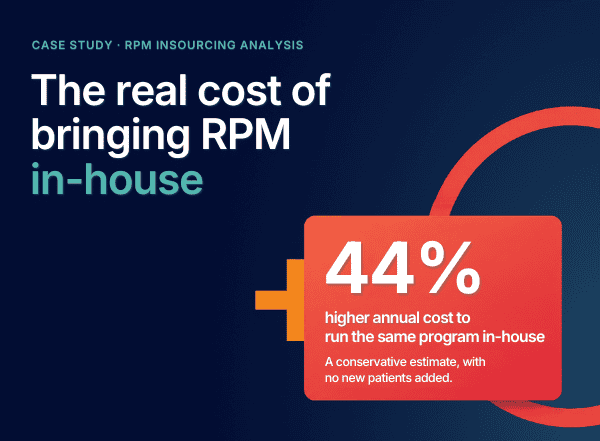
Considering bringing RPM in-house? See what it would really cost.
The Bottom Line
Recently, KFF Health News told the story of Dianne Williams, a patient in rural Georgia whose blood pressure came down because a nurse was watching her readings between visits.
Under the final rule, patients like her don’t lose that care on January 1.
For answers to common questions, read our FAQ on the final 2027 rule. For background on what CMS proposed in July, see our earlier guide. To talk through what the rule means for your practice, schedule a consult.
Source: Centers for Medicare & Medicaid Services, CY 2027 Physician Fee Schedule final rule (CMS-1848-F), published in the Federal Register November 9, 2026. [link: https://www.federalregister.gov/d/2026-22743]
This article is for general information and is not legal or billing advice.