


Compliance by Design
Compliance Is Not Optional. It’s Foundational.
Connected care programs succeed when compliance is built into every step of care delivery.
CoachCare integrates regulatory requirements into every aspect of how care is delivered, documented, supported, and continuously improved.
1. Why Compliance Matters
As connected and longitudinal care models continue to expand, regulatory scrutiny is increasing. Programs that are not properly structured create risk across clinical, financial, and operational areas.
The goal is not simply to meet regulatory requirements. It is to build a care model that can withstand scrutiny while continuing to deliver meaningful patient outcomes.
Compliance does not happen by accident.
It must be designed into the operating model from the start.
2. The Foundation
Connected care programs operate within established reimbursement frameworks. CoachCare is built to align with these models, helping ensure care is delivered consistently, documented appropriately, and supported by compliant workflows.
We focus on execution—not just eligibility.
Common Codes Supported:
- 99453 - Initial patient setup and education for remote patient monitoring
- 99454 - Device supply and data transmission for remote patient monitoring
- 99457 - Clinical monitoring and care management, first 20 minutes
- 99458 - Additional clinical monitoring time
- 99490 - Chronic care management services
- 99439 - Additional chronic care management time
- 99445 - (2–15 days of readings)
- 99470 - (10–19 minutes)
3. Regulatory Framework
Connected care operates within a defined regulatory environment. CoachCare programs are designed to align with key federal and state requirements.
The Rules That Govern Connected Care:
False Claims Act: Supports alignment between services delivered, documentation, and reimbursement.
Anti-Kickback Statute: Guides proper program structure and helps avoid improper incentives that could lead to fraud, waste or abuse.
Stark Law: Governs financial and referral relationships.
State Regulations: Programs must align with applicable state-specific requirements.
4. Care Delivery Best Practices
Care delivery is strongest when every patient interaction follows a consistent, documented process. CoachCare helps standardize workflows while allowing clinicians to focus on personalized care.
Key Elements of Compliant Care Delivery:
- Appropriate patient selection based on medical necessity
- Clear patient consent and enrollment processes
- Accurate, real-time documentation
- Consistent delivery of services • Focus on clinical outcomes, not just activity
- Standard processes that ensure consistency at scale
- Economic arrangements that do not incentivize unnecessary care
5. Contracting Best Practices
Program structure matters just as much as clinical delivery.
Structuring Programs The Right Way: Improper contracting arrangements can introduce significant compliance risk.
Best Practice Guardrails: Avoid fee-splitting arrangements, contingent payments or reimbursement guarantees, and structures that disconnect reimbursement from services actually delivered. We charge the fair market value of our services, irrespective of potential or actual reimbursement.
6. CMS Audits
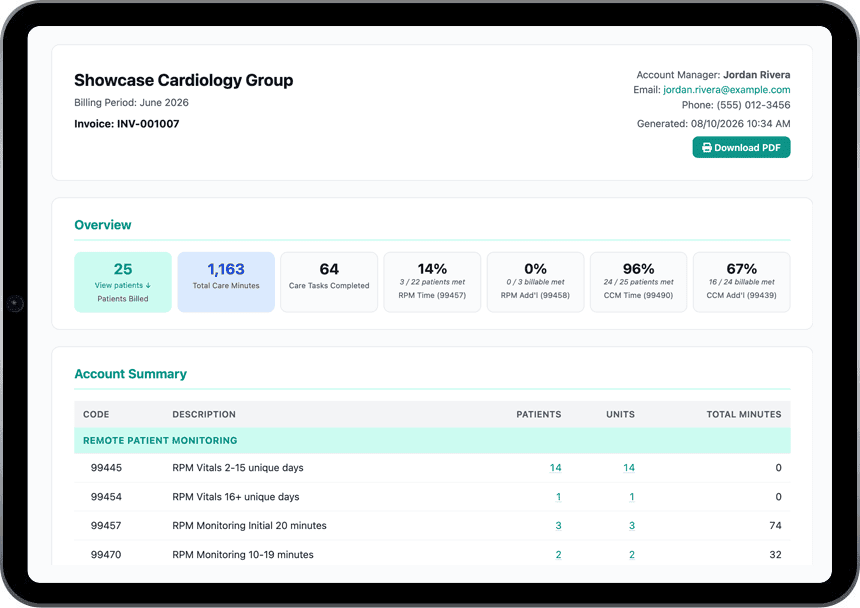
As adoption grows, CMS audits are becoming more common. CoachCare programs are designed to support accurate documentation and audit readiness.
What CMS Looks For:
- Inflated or unsupported time tracking
- Incomplete or inconsistent documentation
- Data that does not align with services billed
- Audit-ready reporting and defensible records
Preparing for Success:
Audit readiness starts before an audit happens.
Structured workflows, consistent documentation, and audit-ready reporting help programs withstand review.

7. Enforcement Landscape
As connected and longitudinal care models continue to expand, regulatory scrutiny is increasing. Programs that are not properly structured create risk across clinical, financial, and operational areas.
The goal is not simply to meet regulatory requirements. It is to build a care model that can withstand scrutiny while continuing to deliver meaningful patient outcomes.
What Recent Enforcement Actions Show: In most cases, risk is driven not by the concept of connected care, but by how programs are implemented.
The Takeaway:
Compliance is not a checkbox. It is a structural requirement of any sustainable care model.
8. Compliance by Design
This doesn't happen by accident. CoachCare's compliance approach is built into how programs are designed, staffed, trained, documented, and reviewed.
Built Into Every Program:
- Independent Compliance Committee oversight
- Retained outside regulatory counsel
- Structured audit-ready reporting
- Built-in documentation and billing workflows
- Integrated patient consent protocols
- Internal & external compliance auditing
9. Training & Oversight
Compliance is reinforced through ongoing training, oversight, and continuous improvement.
Building a Culture of Compliance:
Every CoachCare team member receives training on applicable healthcare regulations and internal compliance expectations, including:
- False Claims Act
- Anti-Kickback Statute
- Stark Law
- Sunshine Act
- HIPAA, privacy, and security
Continuous Training:
Training begins during onboarding and continues through regular refresher programs, including annual HIPAA and security training.
- Onboarding training
- Annual compliance refreshers
- Internal training team support
10. Industry Leadership
CoachCare is setting the standard for responsible remote care.
Founding Member of the Remote Monitoring Leadership Council (RMLC): CoachCare is a founding member of the Remote Monitoring Leadership Council (RMLC), reflecting our commitment to advancing responsible, compliant remote care delivery across the industry.
Our Commitment: Compliance should not be treated as a back-office requirement. It should be part of how programs are designed, implemented, and scaled.
Looking Ahead: We're not just participating in the category—we're helping shape it responsibly.
11. How CoachCare Supports Compliance
Compliance is built into every layer of the CoachCare platform and care delivery model.
Built to Support Compliant Care Delivery: CoachCare integrates compliance into workflows, documentation, oversight, and reporting—helping providers deliver compliant care without adding operational burden.
Key Capabilities:
- CMS-aligned workflows
- Built-in documentation processes
- Ongoing monitoring and oversight
- Support during audits and reviews

Compliance isn't something added at the end.
It’s built into how programs are designed, teams are trained, care is delivered, and documentation is maintained. That’s what builds trust and makes connected care sustainable.