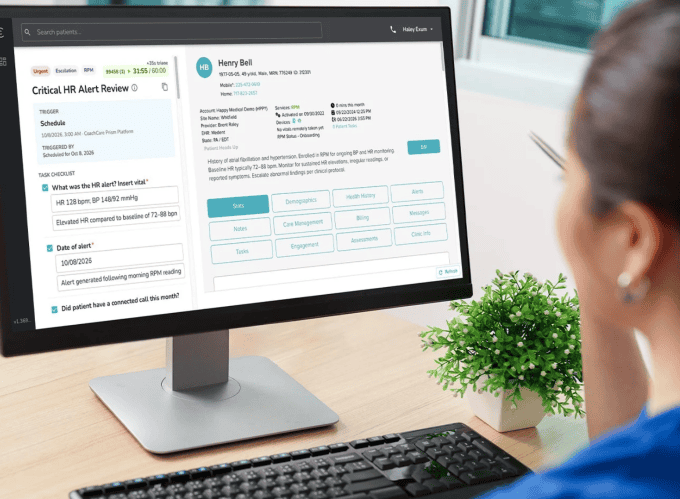


CMS’s Advanced Primary Care Management (APCM) program gives practices a new way to deliver coordinated, relationship-driven care while strengthening reimbursement. CoachCare helps practices operationalize APCM through integrated technology, patient engagement tools, and clinical support designed to extend care beyond the office visit.
Introduction to Advanced Primary Care Management (APCM)
Advanced Primary Care Management (APCM) is an innovative program established by the Centers for Medicare & Medicaid Services (CMS) for 2025. APCM is designed to address longstanding challenges in primary care delivery, including fragmented care, inadequate compensation for comprehensive services, and the need to better support practices in managing complex patient populations and social determinants of health.
At its core, APCM strengthens the infrastructure behind primary care, giving practices the tools, workflows, and reimbursement framework to better support patients between visits, improve continuity, and manage population health at scale.
With APCM, practices can:
- Proactively manage patient populations and identify care gaps
- Strengthen preventive and chronic care management workflows
- Expand patient access through flexible care delivery models
- Support better long-term outcomes through engagement beyond the visit
CoachCare helps practices bring these capabilities into everyday care delivery through integrated technology, patient engagement tools, and clinical support designed to extend care beyond the office visit.
Overview and Purpose of Advanced Primary Care Management
Advanced Primary Care Management aims to strengthen primary care by recognizing and supporting comprehensive, longitudinal care management. Unlike traditional fee-for-service models, APCM bundles various care management services into a single monthly payment. This approach allows practices to focus on delivering high-quality, patient-centered care without the burden of tracking multiple billing codes.
Key objectives of APCM include:
- Enhancing care coordination and continuity
- Promoting team-based care delivery
- Addressing patients’ medical and social needs holistically
- Reducing administrative complexities for providers
- Aligning payment with the value of comprehensive primary care
APCM Codes and Payment Levels
Unlike traditional care management programs, APCM is not time-based, giving practices greater flexibility to deliver care in the ways that best support their patient population.
CMS established three APCM HCPCS codes to support varying levels of patient complexity. Together, these codes create a monthly reimbursement pathway for delivering longitudinal, relationship-based primary care services across the Medicare population.
- G0556: For patients with one or fewer chronic conditions. Approximate reimbursement: $16-20 PMPM
- G0557: For patients with two or more chronic conditions. According to CMS, nearly four in five Medicare beneficiaries have two or more chronic conditions. Approximate reimbursement: $50-54 PMPM
- G0558: For Qualified Medicare Beneficiaries with two or more chronic conditions. For the approximately 8.5 million dually eligible beneficiaries who are QMBs, Medicaid provides assistance for patients to meet Medicare’s cost-sharing requirements. Generally, States cover such cost-sharing on behalf of QMBs, although many states use a “lesser-of” policy through which states pay less than the full cost sharing amounts. Approximate reimbursement: $107-117 PMPM
These tiered payments recognize that patients with multiple chronic conditions or social risk factors require more intensive care management.
*National average Medicare reimbursement shown. Actual payment varies by geography and payer.
Service Elements and Requirements
Advanced Primary Care Management (APCM) includes 13 core service elements that build upon existing Chronic Care Management (CCM) and Principal Care Management (PCM) services, recognizing care management as a core component of advanced primary care delivery. While APCM shares many elements with these programs, it removes time-tracking requirements, allowing practices greater flexibility in how care is delivered while maintaining a focus on comprehensive, longitudinal patient support.
APCM emphasizes the capabilities needed to deliver advanced primary care while allowing practices to tailor services to individual patient needs.
Patient Consent
Inform the patient about the service, obtain consent, and document it in the medical record. The practitioner should also inform the beneficiary that, by providing APCM services, they intend to assume responsibility for all of the patient’s primary care services and serve as the continuing focal point for all needed health care services.
Initiating Visit
For new patients or those not seen within three years.
24/7 Access
Provide 24/7 access for urgent needs to the care team/practitioner with real-time access to patient’s medical records, including providing patients/caregivers with a way to contact health care professionals in the practice to discuss urgent needs regardless of the time of day or day of week. Many practices and systems use nurse call lines or answering services working with standard protocols to provide the initial point of contact after hours and effectively address common problems. In this situation, an escalation protocol will engage a practitioner with system access when needed for decision making. Other successful practices expand hours, add urgent care services or partner with other practices to provide these services, or contract with existing urgent care providers to manage and coordinate care after regular office hours.
Continuity of Care
Ensure continuity with a designated team member for successive routine appointments. There are three components of continuity that improve patient outcomes and experience: relational continuity (“ongoing therapeutic relationship between a patient (and often their family/caregiver)”, informational continuity (“practitioners have access to information on patients’ past events and personal circumstances to inform current care decisions”); and longitudinal continuity (“ongoing patterns of healthcare visits that occur with the same practice over time”)
Alternative Care Delivery
Offer care through methods beyond traditional office visits, such as e-visits, phone visits, home visits and extended hours. By changing where and how care is delivered, practices may have increased availability for patients with complex needs who may be better served by more time-intensive visits in the office, at home, or in a nursing home. Practices would not need to regularly deliver care in all these alternative ways; for example, a practice may routinely offer e-visits and phone visits, but not regularly furnish home visits, and still demonstrate this primary care practice capability. Another practice might offer extended hours on certain days to help patients who may find it hard to take off work to see their clinician, and this would satisfy this practice requirement.
Comprehensive Care Management
Care management is a resource-intensive process of working with patients, generally outside of face-to-face office visits, to help them understand and manage their health, navigate the health system, and meet their health goals:
- Conduct systematic needs assessments.
- Ensure receipt of preventive services.
- Manage medication reconciliation and oversight of self-management.
Electronic Care Plan
Develop and maintain a comprehensive care plan that is accessible to the care team and the patient. The comprehensive care plan for all health issues typically includes, but is not limited to, the following elements: problem list; expected outcome and prognosis; measurable treatment goals; cognitive and functional assessment; symptom management; planned interventions; medical management; environmental evaluation; caregiver assessment; interaction and coordination with outside resources and practitioners and providers; requirements for periodic review; and when applicable, revision of the care plan.
Care Transitions Coordination
Facilitate transitions between healthcare settings and providers, ensuring timely follow-up communication. Key aspects of follow-up after ED visits and hospitalizations include identifying and partnering with the target hospitals and EDs where the majority of a practice’s patients receive care to ensure timely notification and transfer of information following hospital discharge and ED visits.
Ongoing Communication
Coordinate with various service providers and document communications about the patient’s needs and preferences. For example, coordinated referral management with specialty groups and other community or healthcare organizations includes developing processes and procedures to ensure high-value referrals, such as collaborative care agreements and electronic consultations (e-Consults). Additional strategies for addressing common health-related social needs (HRSNs) for a practice’s high-risk patients include conducting needs assessments at regular intervals, creating a resource inventory for the most pressing needs of the patient population, and establishing relationships with key community organizations
Enhanced Communication Methods
Enable communication through secure messaging, email, patient portals, and other digital means.
Population Data Analysis
Use data to develop clear improvement strategies and analytic processes to proactively manage population health, including analyzing patient population data to identify gaps in care. Practitioners already participating in a Shared Savings Program ACO, REACH ACO, Making Care Primary, or Primary Care First satisfy this requirement.
Risk Stratification
Use data to identify and risk-stratify the practice population based on defined diagnoses, claims, or other electronic data, target services to patients, and offer additional interventions, as appropriate. Practitioners already participating in a Shared Savings Program ACO, REACH ACO, Making Care Primary, or Primary Care First satisfy this requirement.
Performance Measurement
Assess quality of care, total cost of care, and use of Certified EHR Technology. Practitioners already participating in a Shared Savings Program ACO, REACH ACO, Making Care Primary, or Primary Care First satisfy this requirement. MIPS-eligible practitioners can satisfy Performance Measurement by registering for the Value in Primary Care MVP. See section below for more detail.
To bill for APCM services, practices must demonstrate capabilities in all these areas. However, CMS proposes flexibility in how these services are delivered, recognizing that care needs and the services provided will vary month to month.
CoachCare’s remote care management platform is well positioned to support APCM implementation and aligns closely with the program’s key elements. Our solutions support timely access to care team support, comprehensive care management, and population health analytics aligned to APCM requirements. Our patient engagement tools facilitate enhanced communication, while our analytics capabilities support performance measurement and quality improvement. This alignment enables practices to transition seamlessly to the APCM model, leveraging our existing remote care management infrastructure to meet new program requirements and improve patient outcomes.
Eligibility and Implementation
Who Can Participate
Providers
APCM services can be billed by physicians and qualified healthcare professionals who serve as the focal point for all needed health care services and are responsible for a patient’s primary care. This includes:
- Primary care physicians
- Family medicine practitioners
- Internal medicine physicians
- Geriatricians
- Qualified advanced practice providers (e.g., nurse practitioners, physician assistants)
Patients
Medicare beneficiaries are eligible for APCM services. The level of service (G0556, G0557, or G0558) depends on the patient’s number of chronic conditions and Qualified Medicare Beneficiary status.
Attribution Process
Patient attribution in APCM is intended to be based on patient choice and documented consent. Specifically:
- Patients must provide consent to receive APCM services from a specific provider
- Only one provider can bill APCM services for a patient in a given month
- Attribution is expected to be reviewed and potentially updated annually
CoachCare’s care management platform includes robust features for documenting and managing patient consent and attribution, enabling easy tracking of patient assignments to specific providers and ensuring compliance with APCM’s single-provider billing requirement. Additionally, our platform’s annual review capabilities align well with the expected yearly attribution update process.
Technology Requirements
To participate in APCM, practices must have certain technological capabilities:
- Certified Electronic Health Record (EHR) Technology: Required to support 24/7 access to care, continuity of care, and management of care transitions.
- Population Health Management Tools: Needed to identify and address care gaps across the patient panel.
- Secure Communication Platforms: Required for enhanced patient-provider communication, including asynchronous options.
- Data Analytics Capabilities: Necessary for performance measurement and quality improvement activities.
As the industry moves towards APCM implementation, practices and health systems will need to assess their current capabilities and identify areas for improvement. Technology solutions can play a crucial role in helping practices meet APCM requirements and deliver high-quality, comprehensive primary care under this new model.
CoachCare’s comprehensive platform has been designed and stands ready to meet these technology requirements.
- Our platform integrates seamlessly with leading EHR systems, ensuring continuity of care and efficient management of care transitions.
- Our platform integrates seamlessly with leading advanced population health management tools, enabling practices to identify and address care gaps effectively.
- Our platform offers secure communication channels that enhance patient-provider interaction, including asynchronous options.
- Our platform’s robust data analytics capabilities support the performance measurement and quality improvement activities required by APCM.
Performance Measurement and Reporting
APCM performance measurement focuses on quality of care, patient outcomes, total cost of care, and the use of Certified EHR Technology. For many organizations, APCM reporting may align with existing participation in Medicare Shared Savings Program ACOs, ACO REACH, Making Care Primary, MIPS, and other CMS quality initiatives.
For MIPS-eligible clinicians, APCM aligns closely with the Value in Primary Care Merit-based Incentive Payment System (MIPS) Value Pathway (MVP), which emphasizes quality measures tied to preventive care, chronic disease management, care coordination, behavioral health, patient-centered care, and screening for social drivers of health.
Performance measurement activities may include:
- Cancer screening and immunization tracking
- Blood pressure and chronic disease management
- Behavioral health and person-centered care measurement
- Care coordination and transitional care monitoring
- Risk stratification and care gap identification
- Population health reporting and analytics
- Quality improvement initiatives tied to cost and outcomes
Practices evaluating APCM should review current quality reporting workflows and assess how APCM requirements align with existing reporting programs and internal operational capabilities.
CoachCare supports APCM performance measurement through integrated reporting, data access, population health analytics, and actionable care insights that help practices identify care gaps, monitor outcomes, and support continuous quality improvement at scale.
Comparison and Context
Benefits of APCM:
- Simplified billing through a monthly reimbursement structure
- Support for proactive, population-based care management
- Improved continuity of care and patient engagement
- Greater alignment between reimbursement and comprehensive primary care delivery
- Stronger support for team-based care models and care coordination
Considerations for Implementation:
- Practice workflow design and operational readiness
- Patient consent and attribution tracking
- Quality reporting and performance measurement alignment
- Staffing, technology, and care management infrastructure
- Coordination across clinical, administrative, and billing teams
CoachCare helps practices navigate these requirements through integrated technology, operational support, and care management workflows designed to make APCM implementation more scalable and sustainable.
How APCM Relates to Other Care Management Programs
Key considerations include:
- Chronic Care Management (CCM): APCM covers many CCM service elements but is billed under a monthly APCM code structure rather than time-based care management billing.
- Principal Care Management (PCM): APCM extends beyond single-condition management to support broader, whole-person primary care delivery.
- Transitional Care Management (TCM): TCM may still be billed separately when appropriate for post-discharge care transitions.
- Remote Patient Monitoring (RPM): RPM may complement APCM and can support broader care management, patient engagement, and monitoring workflows.
- Behavioral Health Integration (BHI): BHI services may continue alongside APCM when clinically appropriate.
- Annual Wellness Visits (AWV): AWVs remain separate and can continue as part of a broader primary care strategy.
Because APCM intersects with multiple Medicare reimbursement pathways, practices should review program eligibility, billing requirements, and operational workflows to determine the best implementation approach for their organization.
CoachCare supports practices through that evaluation, helping teams align clinical workflows, care management services, and reimbursement strategy under APCM.
Resources and Support
Official CMS Documents
For the most up-to-date and authoritative information on APCM, refer to these official CMS resources:
For answers to common practice questions about eligibility, billing, documentation, and implementation, read APCM Questions and Answers: What Practices Asked About Medicare’s New Codes.
CMS Advanced Primary Care Management Services, CMS Overview of APCM services, billing requirements, service elements, and eligibility
CMS Care Management Resources: CMS care management resource hub, including APCM guidance and related program resources.
Medicare Coverage of Advanced Primary Care Management Services Fact Sheet: patient-facing APCM overview, coverage details, and Medicare benefit information.
Industry Analyses and Commentary
Additional APCM implementation guidance, reimbursement updates, and policy analysis:
- American Academy of Family Physicians: Using Advanced Primary Care Management Services
- National Association of Community Health Centers: APCM Reimbursement Tip Sheet
- Rural Health Information Hub: Advanced Primary Care Management
These resources offer additional perspectives on APCM implementation, quality reporting, reimbursement strategy, and operational planning for practices adopting advanced primary care delivery models.